
✦ Experiences
Experiential medicine: travel with purpose.
People grow at the edge of what they are used to. In our understanding of human physiology, this concept is well understood and defined as "hormesis": a controlled dose of stress is what builds capacity, which is why training works. The same holds for the mind, and the demand does not have to be physical. Once or twice a year we take a small group somewhere that asks something of them, and they come back more resilient for it.
✦ Finse
Discover the Hardangervidda plateau.
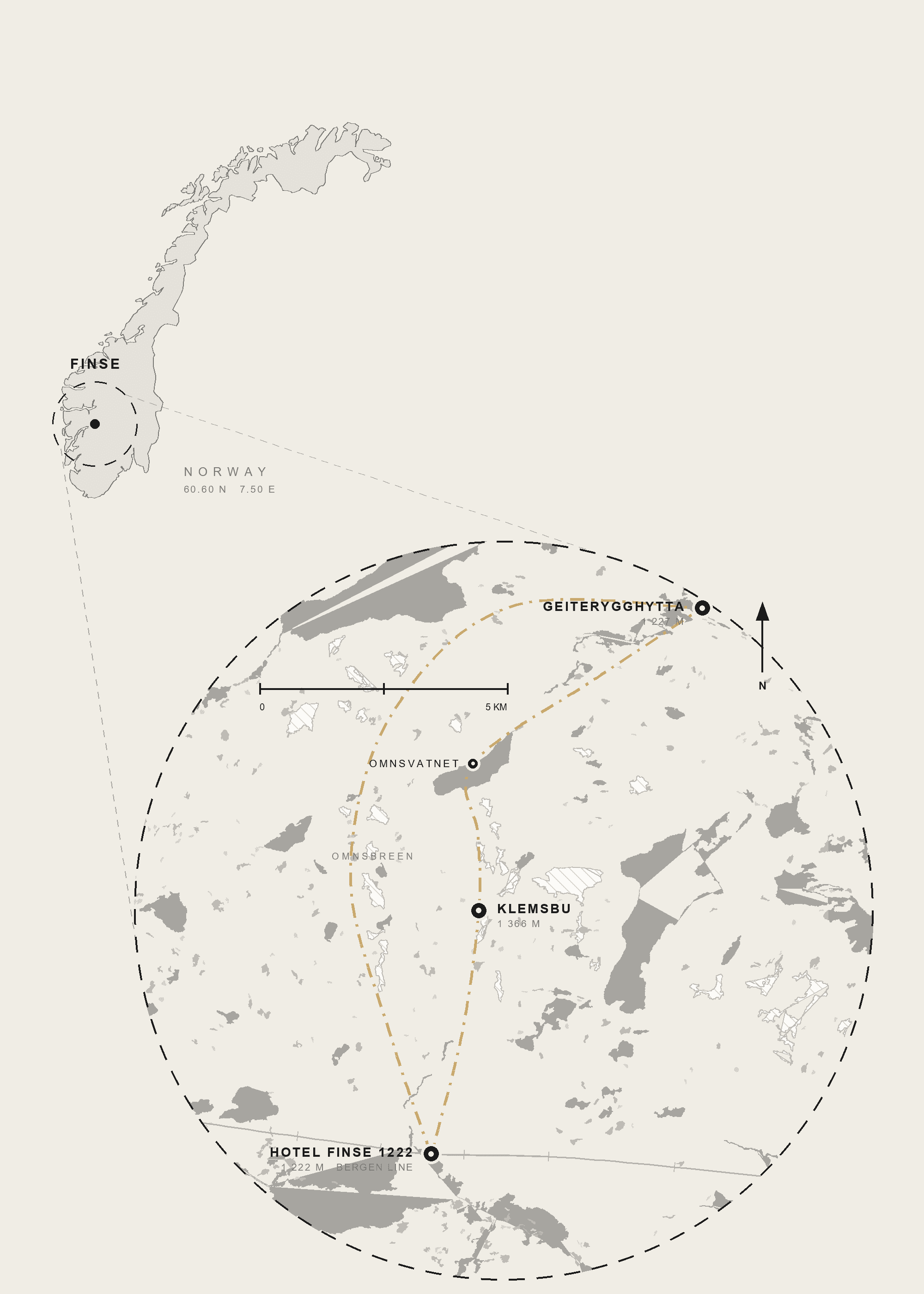
Finse sits at 1,222 metres on the edge of the Hardangervidda plateau in Norway, at the highest point on the Norwegian railway. No road reaches it. You arrive by train, and after that you travel on foot or on skis. Scott, Shackleton and Amundsen all trained here before they went south, and the station and the hotel are still most of what is there.
The plateau runs to roughly 6,500 square kilometres, the largest in northern Europe. It is treeless and wind-scoured, scattered with lakes, and lies well south of the Arctic Circle while carrying an arctic climate anyway. Europe's largest herd of wild reindeer lives on it, and the Hardangerjøkulen glacier is immediately to the south.

6 days in the wild.
We take small groups to the plateau every winter, over six days, the first of them learning to move and live on it, skis and pulks, camp craft, navigation, and the discipline of staying warm and fed when it is cold and the light is flat. Then a three-day, sixty-kilometre crossing as a team.
Professional polar guides lead it and Curia Health physicians travel with the group. There is no phone signal for most of it, which is part of the point. What people talk about afterwards is rarely the distance.
An example itinerary
On the science of adversity

✦ Membership
With purpose.
Setting stretch goals drives change. The training in the months before is tailored to your own physiology and built around a specific objective, so every session in between has a point beyond knowing you should do it. Fuelling, sleep and recovery follow from that, and they have a direction instead of being general advice.
Your team plan it with you, and one of them comes too. We practise what we preach.
✦ Taking part
How to come.
The experiences are open to anyone, subject to fit. You do not need to be a member, and you do not need previous polar experience for Finse. What you do need is to be able to move under your own power for a full day in the cold, sometimes in poor visibility, and to be someone a team can rely on.
✦ For a team
A team can take the week outright.
Everything above is written for one person. A company can also book an experience exclusively for a team, run by the same guides and the same clinicians, with the work starting before they travel and continuing after they get back.
✦ What comes next
Not everything worth doing has to be cold.
Finse is where the programme started, and it is not where it ends. We are building toward a wider set of experiences: different places, different demands, and formats that ask something of people who would never choose a polar plateau.
The principle stays the same. Somewhere that asks something of you, a small group, and time away from everything that usually has your attention. The demand does not have to be cold, and it does not have to be physical. Somewhere large enough to make a person feel small does its own work, and so does going long enough without a signal for attention to come back.